
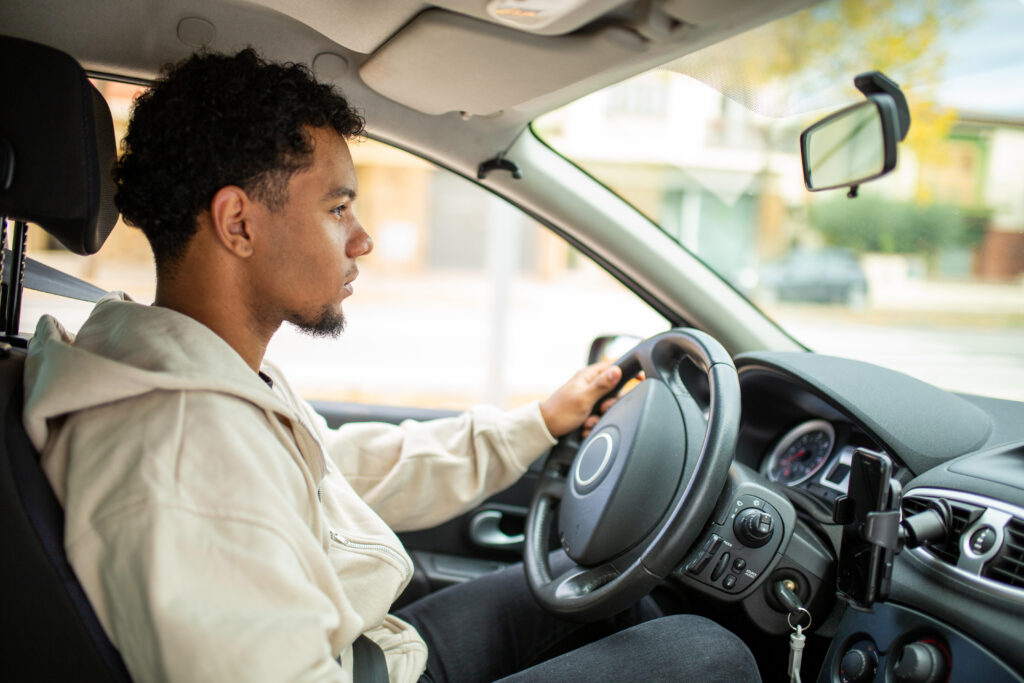
Most drivers know that safe driving apps exist and that they can lower a premium, but far fewer understand exactly what these programs are measuring, how the data actually gets collected, or what happens to that information once it leaves your phone. Understanding the mechanics behind telematics changes how you use these programs, since knowing exactly what counts against you makes it much easier to actually earn the discount instead of unknowingly working against yourself.
The Three Ways Insurers Actually Collect Driving Data
Telematics programs generally rely on one of three collection methods, and which one your insurer uses affects both the accuracy of the data and what it’s capable of tracking. Smartphone apps are the most common approach today, using the phone’s built-in GPS, accelerometer, and gyroscope to detect speed, sudden braking, sharp cornering, and even whether you handled the phone while the car was moving. Plug-in devices that connect to your vehicle’s OBD-II port, the same diagnostic port a mechanic uses to read error codes, offer a more direct read on the car’s internal systems, capturing things like engine RPM and precise acceleration patterns without depending on a phone’s battery or sensor calibration. The newest category involves telematics built directly into the vehicle itself, where the manufacturer’s onboard systems continuously monitor and transmit driving data without requiring you to install anything at all, a setup that’s becoming increasingly common in newer vehicles equipped with connected car features.
Each method has tradeoffs worth understanding before you enroll. Phone-based apps are the easiest to set up and require no extra hardware, but they can occasionally misread events, mistaking a rough pothole for a hard brake or picking up phone movement that has nothing to do with actual distracted driving. Plug-in devices tend to produce more reliable data specifically about the vehicle’s mechanical behavior but can’t detect phone handling at all, which matters if your insurer’s program includes a distracted driving component. Built-in vehicle systems are generally the most comprehensive, since they can pull data directly from the car’s sensors continuously rather than relying on a phone that might occasionally lose signal or run out of battery mid-trip, but they also raise the most significant privacy questions since the data collection is constant and automatic rather than something you actively choose to enable trip by trip.
What Actually Gets Scored, and What Doesn’t
The specific behaviors that affect your discount vary somewhat by insurer, but most programs are built around a consistent core set of metrics. Hard braking events, typically defined as a rapid deceleration over a short distance, are one of the most heavily weighted signals, since they’re interpreted as evidence of following too closely, reacting late to hazards, or general inattention. Rapid acceleration gets flagged similarly, since aggressive throttle use correlates with higher accident rates in the underlying data insurers use to build their scoring models. Late-night driving, generally defined as trips occurring after roughly eleven at night, is scored as inherently riskier regardless of how smoothly you actually drive during that window, since accident severity statistics are measurably worse during those hours across the entire driving population, not just for any individual driver.
Phone handling while the vehicle is in motion has become an increasingly significant factor as apps have gotten better at detecting it, using a combination of motion sensors to distinguish between a passenger using their phone and a driver doing so. Total mileage factors in as well, on the logic that more time on the road simply creates more opportunities for an incident to occur, independent of how carefully any individual trip is driven. What generally doesn’t factor in, despite common assumptions, is the specific route you take or which neighborhoods you drive through, since most telematics programs are built around behavioral metrics rather than location-based risk scoring, though this can vary by program and it’s worth checking your specific insurer’s documentation if you’re unsure.
Where the Data Actually Goes After It’s Collected
Once your driving data is captured, it typically travels through a cellular or cloud-based connection back to the insurer’s systems, where it’s processed into a composite score rather than being reviewed trip by trip by an actual person. That composite score is what actually drives your discount or surcharge, meaning a single rough drive home during a thunderstorm usually won’t meaningfully move your rate on its own, since the scoring is built around patterns across dozens or hundreds of trips rather than any single event. This is worth understanding because it removes some of the anxiety people feel about telematics programs, since the system is generally designed to reward consistent behavior over time rather than punishing you for one bad night.
What’s less well understood is how long that data gets retained and what else it might be used for beyond the immediate discount calculation. Regulatory scrutiny in this area has increased recently, with federal action taken against at least one major automaker over allegations that geolocation and driving behavior data was collected and shared without sufficiently clear consumer notice, a reminder that the data collection happening through connected vehicle systems can be more extensive and less transparent than most drivers assume. Before enrolling in any telematics program, it’s worth taking a few minutes to actually read the privacy disclosure rather than skipping straight to the sign-up button, specifically checking what data is collected, how long it’s retained, whether it can affect your rate at renewal even after the initial program period ends, and whether you have any ability to review or dispute individual trip data if something seems inaccurately flagged.
Getting the Most Out of a Program Without Overthinking Every Drive
The practical goal here isn’t to drive in a state of constant anxiety about being scored, since that defeats the purpose of a program meant to reward habits you’d ideally be practicing anyway. A few genuinely useful adjustments tend to move the needle more than obsessing over every individual metric. Leaving more following distance naturally reduces hard braking events, since it gives you more room to slow down gradually rather than reacting at the last second, which has the added benefit of actually being safer regardless of whether you’re being scored. Using a phone mount and enabling do-not-disturb or driving mode settings addresses the phone handling metric directly, and it’s a change most people can make once and then forget about entirely rather than something requiring ongoing effort. Being mindful of trip timing helps too, since consolidating errands into daylight hours when practical avoids the automatic penalty attached to late-night driving windows, though this obviously isn’t always possible depending on your work schedule or personal circumstances.
The discounts available through these programs, often ranging from a modest single-digit percentage up to twenty or thirty percent for consistently safe driving profiles, are real enough to be worth the small adjustment period most people go through when they first enroll. Understanding exactly what’s being measured, rather than guessing or assuming the worst, is what lets you actually capture that discount instead of leaving it on the table because a rough first week made the whole program feel not worth the effort. If you’re currently paying full price without any telematics discount factored in at all, it’s worth comparing what a usage-based program could realistically save you against your current premium before dismissing the idea outright.